Over the weekend, I had the joy of being able to finally present the work I did in Roman Rainbows. Calontir holds two major arts and sciences competitions per year: Queen’s Prize, the novice-level competition (I had the great joy to sponsor two amazing scribes; one who won the Populace Choice and got her Calon Lily, which means she can sponsor next year, and the other won the whole thing and is well on her way in creating incredible scribal works) and Kingdom Arts & Sciences Tri-levels and Championship, which is where it is open to all. The A&S Championship is one where those vying to win present three items judged at an advanced criteria (Calontir A&S Criteria are located here). People also have the opportunity to just display their work without it being judged.
Not going to lie; I’ve been dealing with a ton of life outside of work, but I took a look at what I’d done with Roman Rainbows, knew I hadn’t really taken it for Kingdom A&S, and went “screw it” and entered into a display category. Display categories at K A&S mean that it is not subject to an evaluation session, but it does mean that people can just come by and geek about what you’re working on at any one particular time.
I know myself a bit too well when it comes to competition, and I especially know that competitions stress me out a lot. I do not need more stress in my life, thank you very much. But also, part of what competitions do is show to others what you know, and gives a relatively low barrier access to allowing people to take a look at what it is that you enjoy doing.
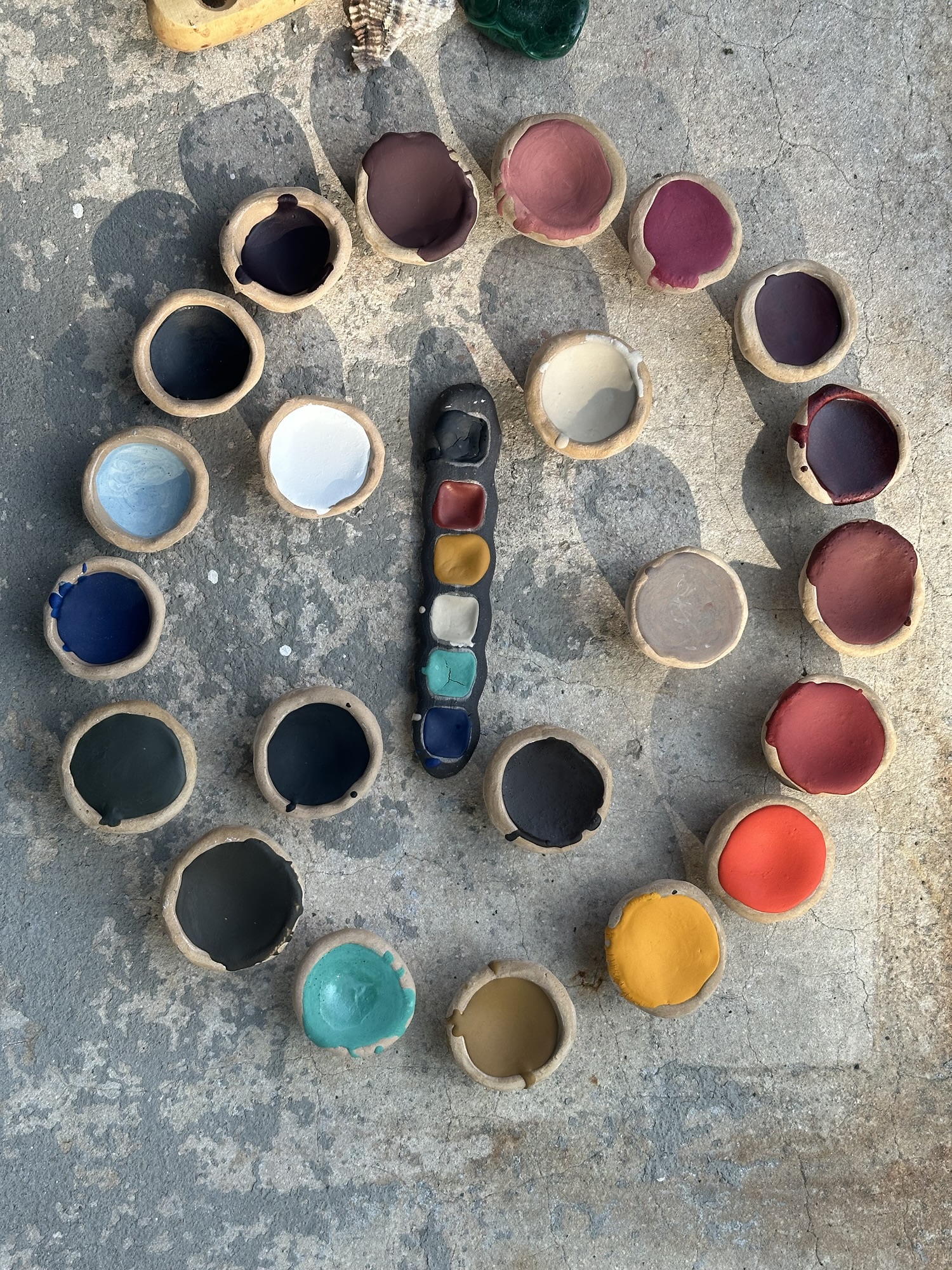
That said, competitions are also there to challenge people to go for the gutsy and the fabulous. Me just having pots of gouache paint was just. . .it lacked some sort of appeal. Pretty, but not much substance. There is more to the story of what goes into paintmaking besides pigment and binders. So I went back to the Grifa study, the May 2025 study that gave me the idea to even attempt a plausible Imperial-era Roman palette, and I went “I got pigments. I got rocks. I can get a map.”
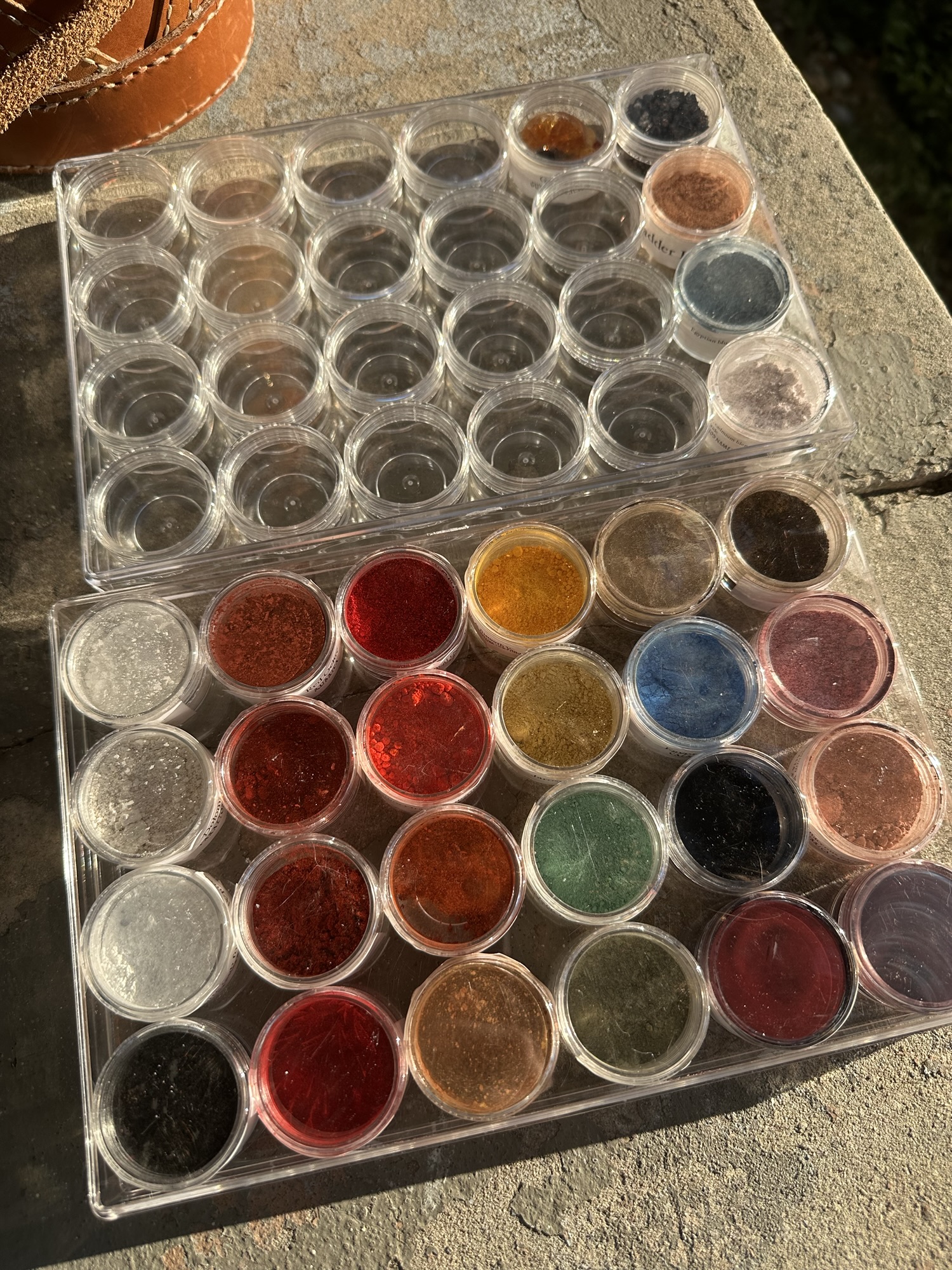
The first thing I did was recreate the pigments as they were generally found in situ. Having the gouache versions is nice, but the difference is that gum arabic can darken the appearance of some pigments, so showing how the pigments could have looked at Pompeii (and having them properly labeled in little plastic see-through jars was important). I also took the opportunity to place items like ground madder root, cochineal beetles (yes, I know, New World, but they produce carminic acid like kermes lice), and even a little bit of gum arabic in its raw form, as studies of Roman-era Fayuum portraiture show a use of gum arabic. (Pliny the Elder also mentions it as an artist material.)
The labels were not quite big enough to give a location, alas, but. . .
One of the things I’ve been really interested in how pigments were sourced, how they get to artists, and how much time an artist would spend either making or collecting those pigments for themselves.
By the time of the Italian Renaissance, and specifically 15th c Venice, colour and pigment sellers, known as vendecolori would set up shops in taverns and inns with specific sign names. Florentine artists during the Renaissance often would purchase their pigments and artist materials from apothecaries. Of course, this is well over a thousand years past Imperial Rome, however, it makes some amount of logical sense that an artist would not be producing much of their own materials to work with, and that is certainly also true within Imperial Roman society.
Going back to Pliny the Elder’s Natural History, Pliny speaks of locations where some materials were sourced, though, because this is Pliny, who will take several sentences to explain a fairly simple concept or isn’t exactly clear on the geography, only gives a limited number of locations where the raw materials were sourced from.
Chapter 35 of Natural History covers the bulk of the artists known to Pliny or the materials that were used. Within this chapter, Pliny talks about the character of colours. Some colours are sombre, and others are brilliant, with the brilliant colours being provided to the artist by the patron1. Within even this divide are natural and artificial colours, which separates pigments like ochre from created ones like red lead.
| Pigment name | Modern name | Colour | Sombre or Brilliant | Natural or artificial | Location listed in Pliny | CI Pigment number |
| Sinopis, red ochre, or ruddle | Red ochre | red-brown | Sombre | Natural | Pontus (Anatolia), Egypt, the Balearic Islands, Africa; best source found in Lemnos and Cappadocia | PR102 |
| Paraetonium | Chalk white | dull white | Sombre | Natural | “Place of that name in Egypt“ | PW18 |
| Melinum | Could be aragonite, kaolin, or calcite | dull, greasy white | Sombre | Natural | Island of Melos | PW18 |
| Ceruse | lead white | bright, warm white | Sombre | Natural | Initially found in Smyrna in Anatolia, but now “made with lead in vinegar” | PW1 |
| Burnt ceruse | Red lead | bright orangey red | Sombre | Artificial | Found by burning lead in pots | PR105 |
| Eretrian Earth | White earth, probably kaolin | two kinds: white and ashy grey | Sombre | Natural | “Named for the country that produces it“ | PW19 |
| Sandarach or realgar | Arsenic sulfide | Like a flame: bright orangey red | Sombre | Artificial | products of the island of Topazus in the Red Sea, but not imported to Italy | PY39 |
| Black | number of sources; mostly carbon blacks | Black | Sombre | Artificial | Made from burning anything from “charred remains from graves” to “soot produced by burning resin or pitch” | PBk7 |
| Dark Purple | Tyrian purple soaked into white earth, though combined with “combines most easily with hysginum and madder” to augment the colour | Tyrian purple | Brilliant | Natural | “Puteoli is more highly praised than that of Tyre or Gaetulia or Laconia“ | NV1 |
| Indigo | Indigo | Indigo | Brilliant | Natural | India, “being a slime that adheres to the scum upon reeds” | NB1 |
| Armenian blue | blue; could be ultramarine however Pliny talks about this being a thin blue of which lapis is not | Probably azurite | Brilliant | Natural | Kingdom of Armenia | PB30 |
| Appian green | terre verte | dark, dusty green | Sombre | Probably natural | Doesn’t say | PG23 |
| Cinnabar | Cinnabar | Bright red | Brilliant | Doesn’t say | Doesn’t say | PR106 |
| Dragon’s Blood | Dragon’s Blood | Blood red | Brilliant | Doesn’t say | Doesn’t say | NR31 |
| Gold-solder | Malachite | Soft green | Brilliant | Natural | Doesn’t say | PG39 |
While I had plenty of the locations, the last few did not provide enough information, nor did Pliny really discuss in depth the preferred blue of the Roman Empire, Egyptian Blue. However, Vitruvius in De architectura discusses the process in making it, and the Grifa study outlined a pot of Egyptian blue was found at Pompeii. Per archeologists, Egyptian blue factories had been moved from Alexandria, Egypt to Pozzuoli, near Naples2.
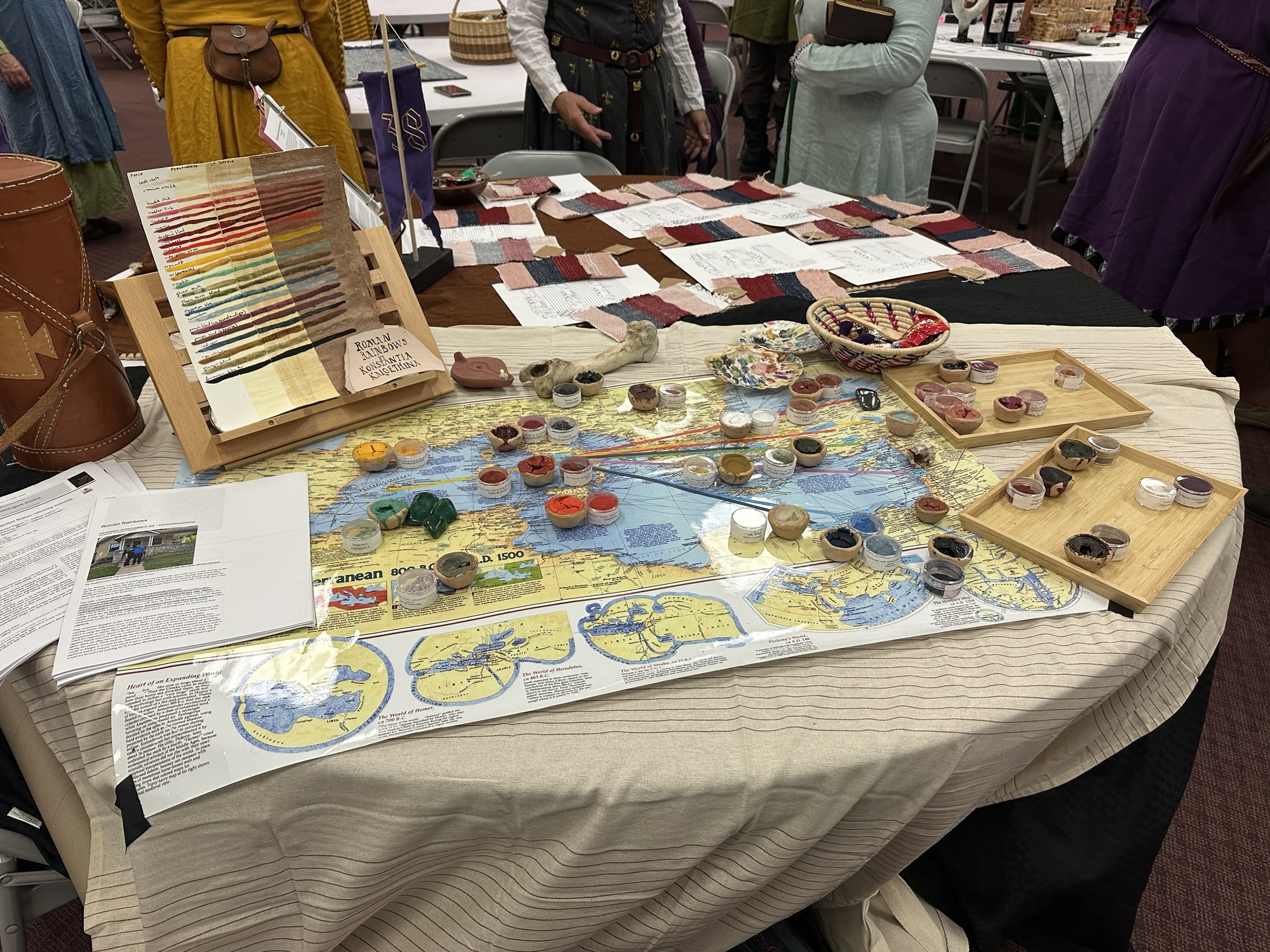
So I went all Charlie Day and took a map of the Mediterranean, and labled with washi tape as many places as I could find listed as to where the pigments were located.
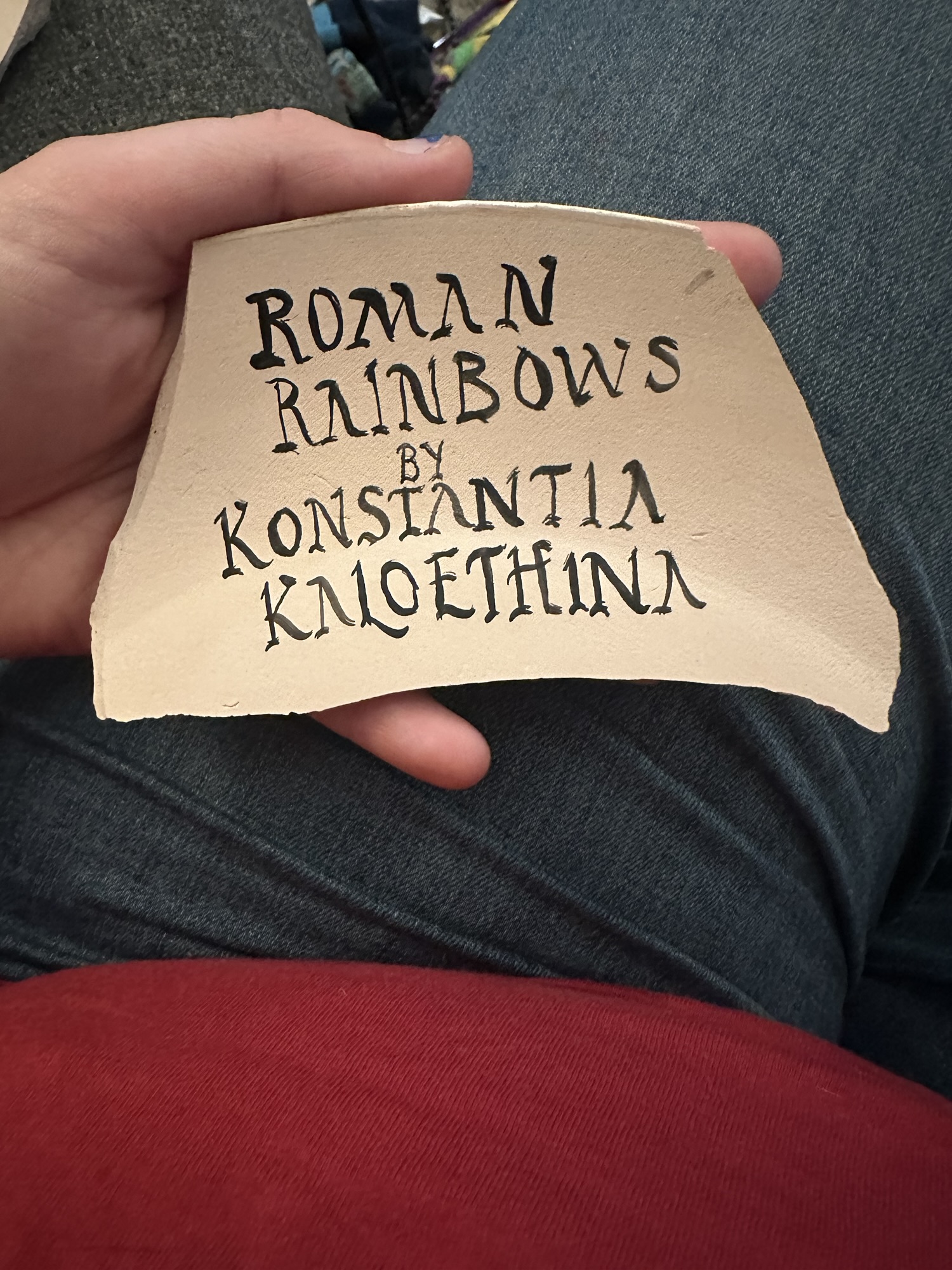
I also made my own ostracon with a plate my mother-in-law made but the foot broke, so it was not going to be a functional plate. So. . . I smashed it on my back stoop, collected the shards, and selected the nicest looking one that wasn’t painfully sharp. I then took a bit of acrylic paint, I used a rustic Roman script to place my name and project name on the smashed bit. Yeah, pretty pleased with that, even if the brush was pretty much dead and didn’t quite do what I wanted it to do.
Lastly, I took four common artist’s substrates (paper, pergamenata [vegetable vellum], and two colours of papyrus, and glued these together in a way that would best allow me to show the general qualities of the pigments in the gouache base. Some pigments, even if the pigment pack is high, have low coverage, while others have high coverage but may not be as lightfast. Being able to show all of the colours in use together in context was important.
How this all came together, however, filled me with joy.
Map went first, then the pigments and finished paints were placed nearby their labeled locations along with raw versions of the materials being used by the artists. The display of the sample sheet plus the ostracon went on a book easel. Copies of Roman Rainbows (I was lazy and just printed my blog post) and the Grifa study were available for people to read.
I got a lot of really excellent feedback, and I’m excited to learn more about the pigment trade in period, and just how complicated the trade networks really were, even within this time period. But also, by entering in display, I could take some of the pressure off in creating a cohesive entry while also presenting something that makes me proud to know I researched. Additionally, it is helping me gauge interest in a class regarding Roman trade into later period pigment and artist material trades.
- Pliny the Elder, Natural History. Chapter 35.12 https://penelope.uchicago.edu/Thayer/L/Roman/Texts/Pliny_the_Elder/35*.html#xii ↩︎
- Dariz, Petra, and Thomas Schmid. “Trace compounds in Early Medieval Egyptian blue carry information on provenance, manufacture, application, and ageing.” Scientific reports vol. 11,1 11296. 28 May. 2021, https://pmc.ncbi.nlm.nih.gov/articles/PMC8163881/ ↩︎

