I like being a bit of a free-range scribe. Last year, I completed three scrolls (Marguerite’s Laurel, Ryan’s Golden Mantle, and a scroll blank for TRM Calontir that I didn’t blog about, but also, just know it’s a Mira and I did it fully at the event using almost all handmade paints and iron gall ink, as well as one giant Japanese banner for my friend Uji. So, when my friend Camille (current EK Signet) knew I was coming to Birka, she asked if I wanted to do a scroll (or two) to go out.
Thankfully, I had snow days and a wild hair to do something ridiculously tiny. I like doing to scale pieces, especially smaller ones, as they are detailed but not so detailed that it doesn’t seem to stop. I also really, really like working small, because as a left-handed scribe, it means that my chances of smearing are less likely to happen.
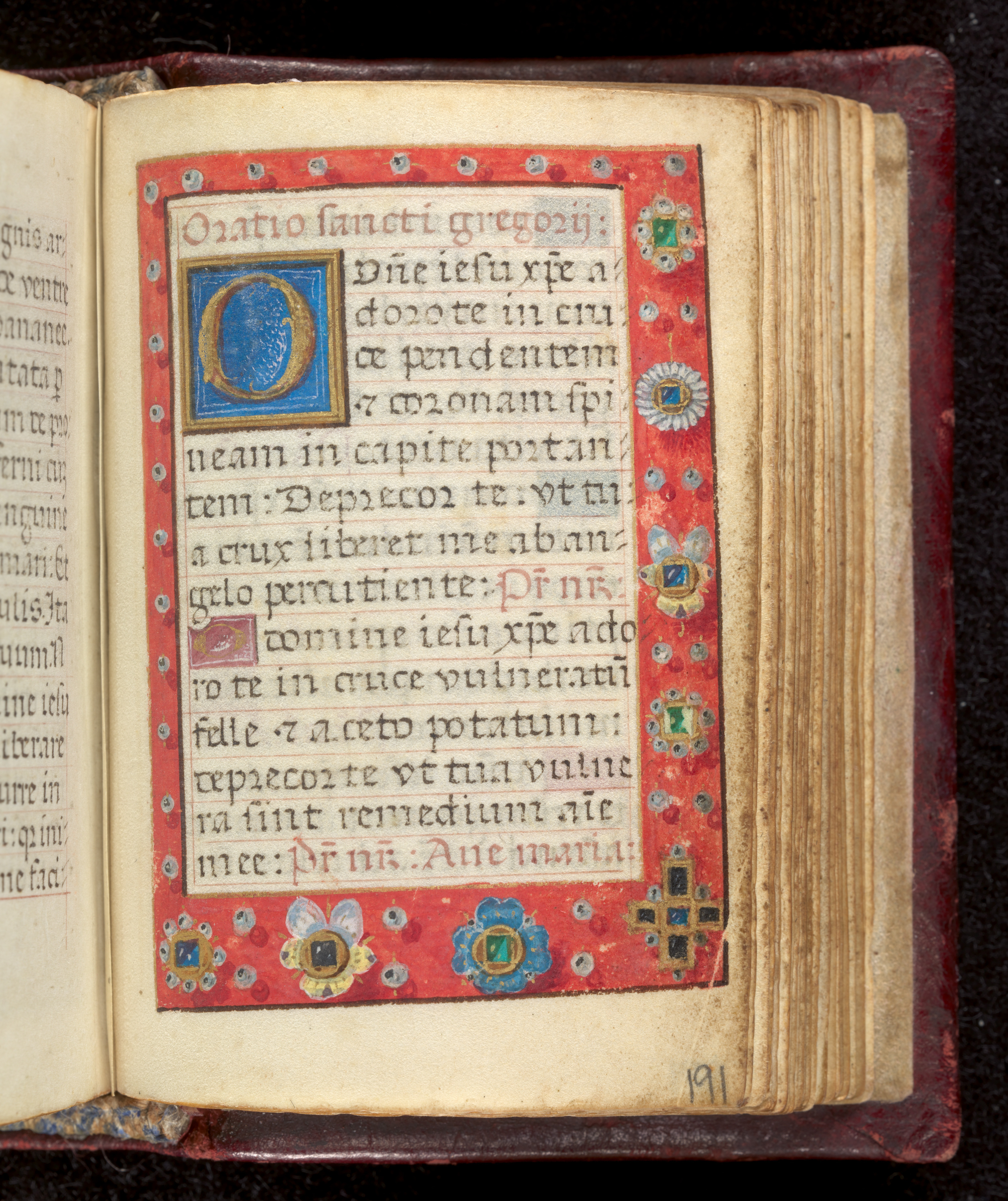
Anyway, Camille asked if I’d be willing to do a scroll. I opted for a Simon Bening Book of Hours. One, Simon Bening was a mad genius in that many of his commissioned works are tiny little things, and two, his portraiture work is phenomenal at any scale, but more so at the miniature sizes he generally worked at.
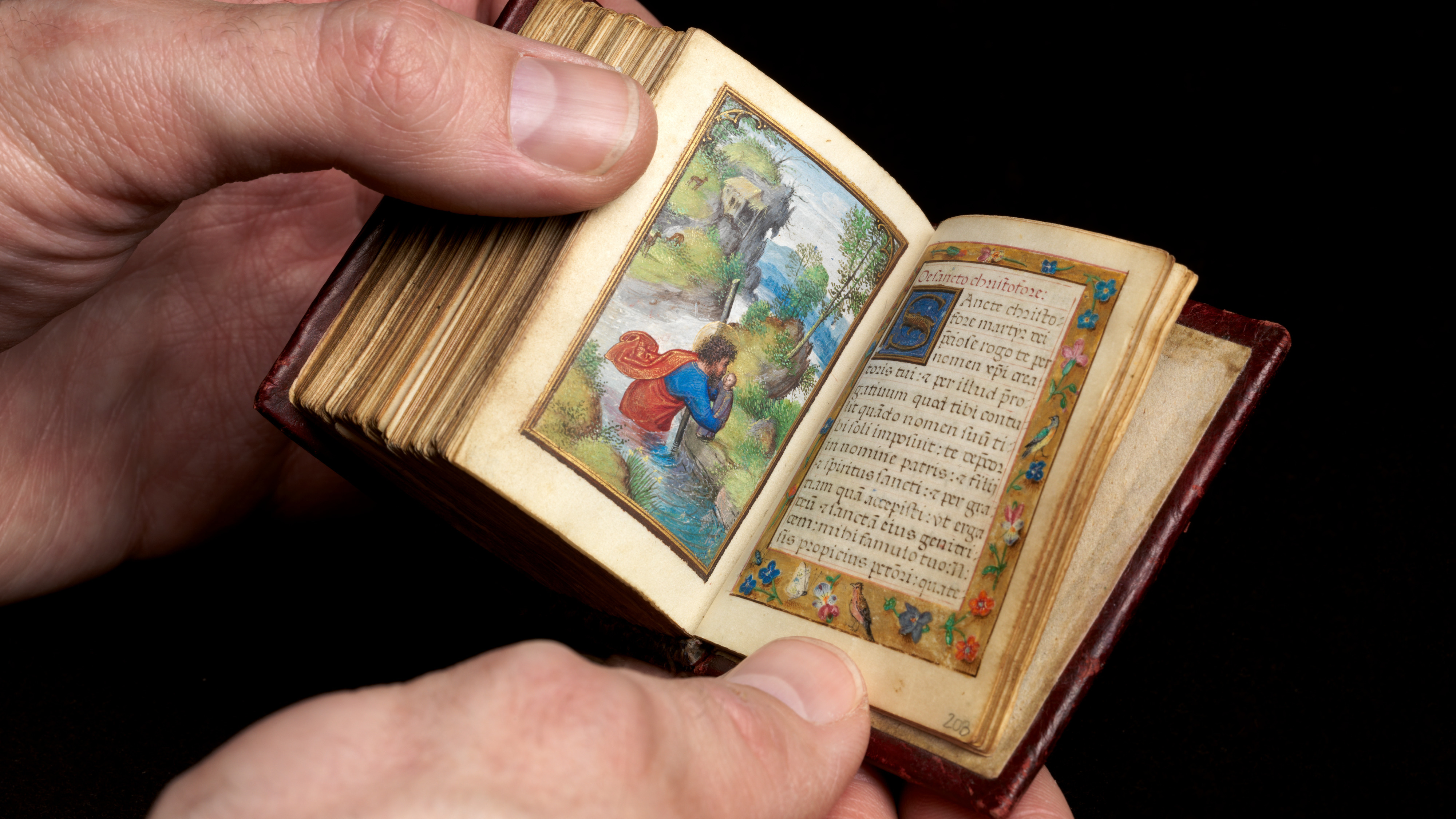
Given that the extant was a book, it meant that margins tend to be on the smaller end, which can present issues when framing, but I pushed ahead using the dimensions given in the provenance. The illumination areas only were 1 7/8 × 1 5/16 in. (4.8 × 3.4 cm), and the areas for text were 1 7/16 in. × 1 in. (3.6 × 2.6 cm).
So, I took the smallest existing sheet of pergamenata that I had (a 5″x7″ piece of natural-coloured paper) and measured out everything. Margins, writing areas, and places for portraiture. And then I paused. There is not a lot of room. I even screwed up the calligraphy a couple of times to the point I couldn’t fix it and just started over. (I seriously have two little parts on the remaining perg with Xs through them to remind me that they were not good for this project.)
One of the things I’ve struggled with on doing calligraphy for these tiny pages has been finding nibs small enough. It was a place I struggled with on Grimwulf’s Calon Cross, and I struggled with here. I was able to request very short scroll texts from the text writers (thank you Gwillim and Karl!) and used a very trusty .005 Micron to do the calligraphy. In period, our main man Simon Bening (or one in his studio, because we don’t know who the calligrapher is) used a quill pen, but given that he “served as a dean of the calligraphers, booksellers, illuminators and bookbinders in the Guild of Saint John and Saint Luke three separate times (1524, 1536, 1546)1,” he might have had some mastery at this.
I am most decidedly not Simon Bening. Don’t get me wrong, I would love to have his mastery, but I also have a day job.
Anyway, I used my ever-trusty Micron and attempted to make English words look like Latin words. Part of my practice when doing scribal, especially if I’m doing calligraphy and illumination is to do the calligraphy first. This can sometimes be hard in creating a ductus in that some letters exist in English that do not in Latin (K or W, for example), but knowing that the general hand of this piece was a modified humanist/Foundational hand, I could extrapolate from later exemplars and make it at least not jarring with the rest of the piece. I was able to use the Met’s online entry on the Book of Hours and flip through to see how various letters were created, and could sort of create a bit of a ductus.
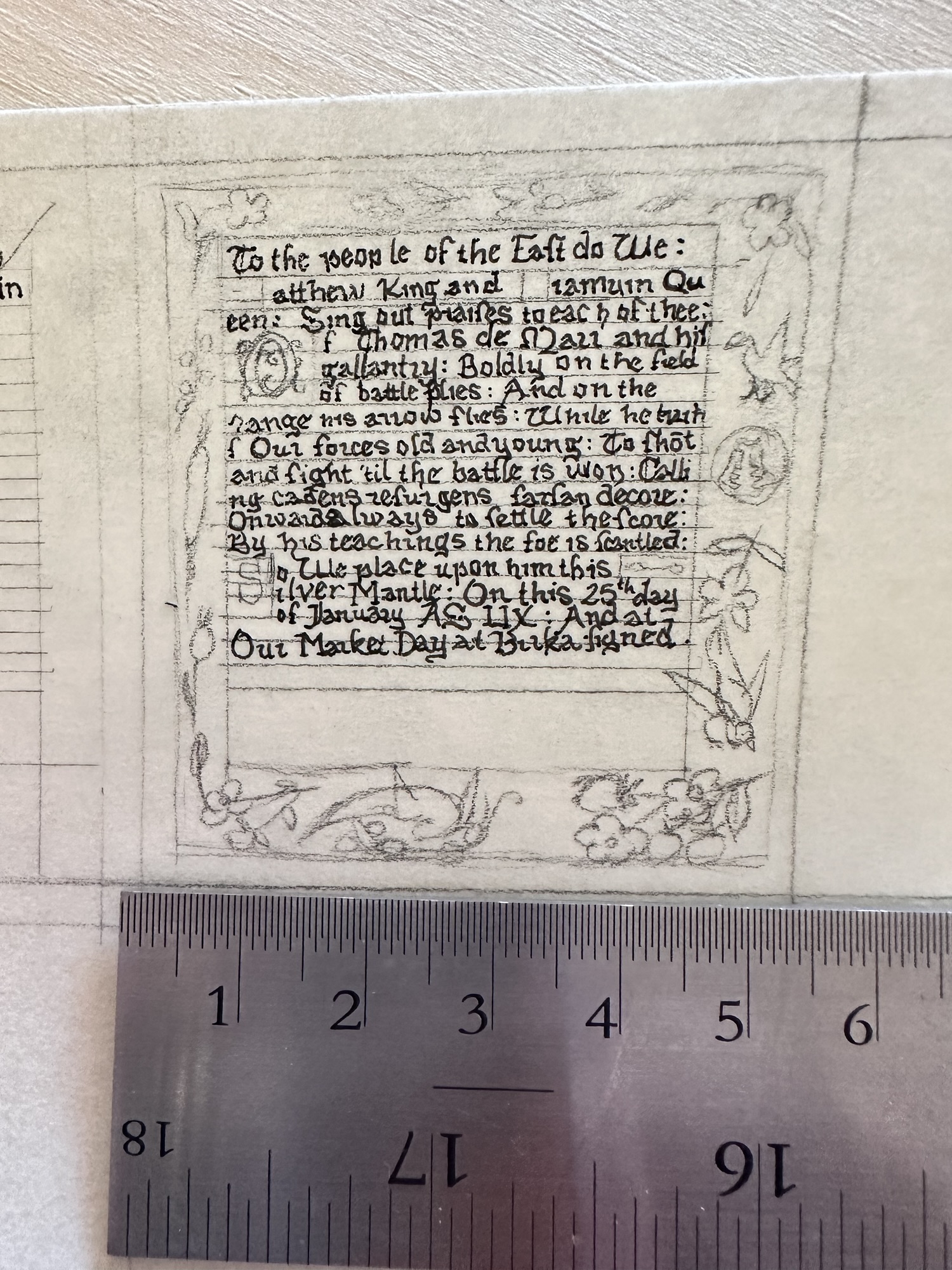
When using a round nib like a Micron, one of the things that one can do to make letters look like calligraphy is to vary the pressure on the plastic, round nib to get thicks and thins. Another thing that can be done, though it ruins the nib and can cause ink flow issues, so slightly flattening the nib on the side. Is it the same as using a quill or a metal nib? Well, no. But as I have yet to find a small enough nib to do this size, and my ability to get a quill this small doesn’t exist, I’m happy to use the Micron to do it.
As for paint, I used my own handmade paints: cadmium red medium (instead of vermillion, which was probably what was used for the strong warm red), azurite, ultramarine, yellow ochres (a variety; I used Italian gold ochre and a darker yellow ochre), a vergaut made from indigo and Italian gold ochre, malachite, Bohemian Green Earth, viridian, Indigo green (made from a combination of indigo and weld), carmine (made from real bug butts!), furnace black, burnt umber, raw umber, burnt sienna, titanium white, and vivianite. I also used FineTec’s Olympic Gold and Premium Real Silver square pans, as the price of metals means that mica-based solutions are best for my wallet.
Of these, the ones that are not known in period are the cadmium red, viridian, titanium white, and the FineTec formulations. I was absolutely surprised that vivianite was used in some German pieces2, but on the whole was a rare pigment (which it remains, as it does oxidize based on light, and changes to a blue-gray-brown from a dark indigo blue). Viridian was used instead of verdigris, as verdigris is extremely acidic (it’s copper acetate, and when I make it into paint, I can feel the acid of the pigment through my gloves). Because verdigris is this acidic and can and will eat through both parchment and paper, I cannot consider it an archival quality paint. Viridian is close enough in colour without being as destructive.
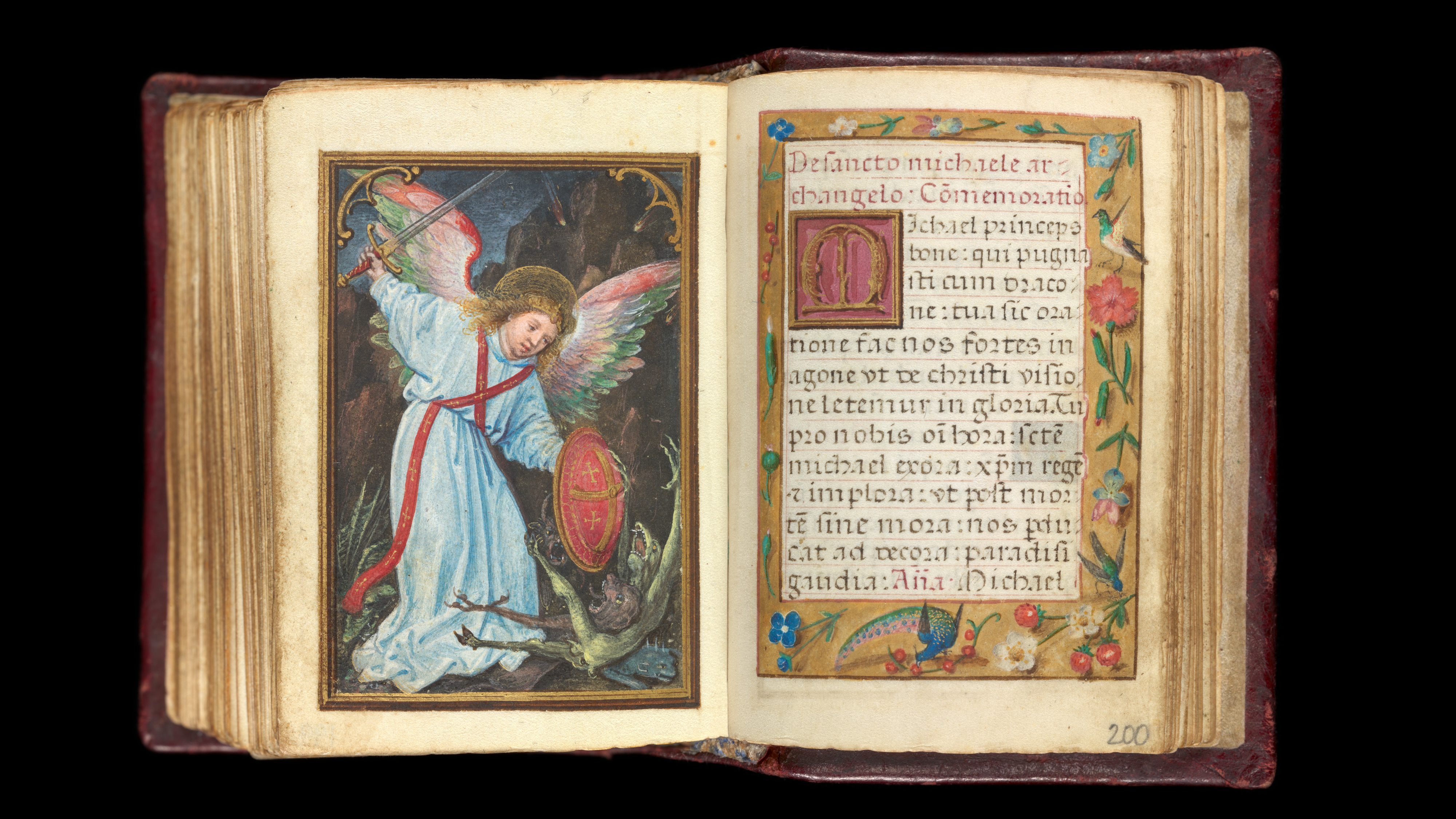
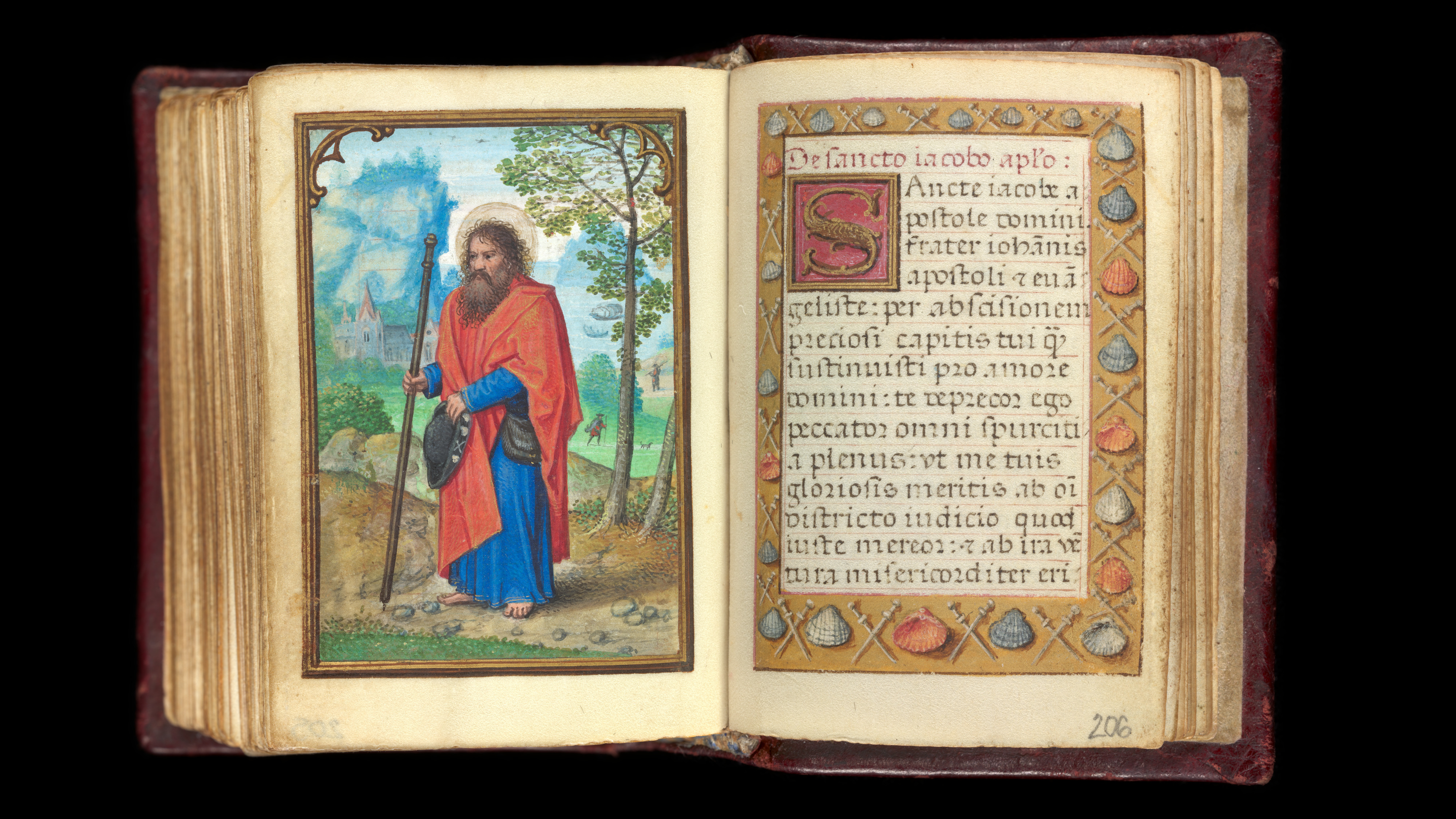
I definitely had to do some social media stalking to make sure I got a decent portrait. One of the things that I love about Simon Bening is his soft skies (I had to water down my indigo a lot) and his relatively soft backgrounds. I really enjoyed Simon Bening’s portrait of Saint James the Greater (as depicted with pilgrim staff, pilgrim hat, pilgrim bag, and compostela, as well as staves and compostelas on the next page). I thought it would give the right look for someone known to do archery, especially since a lot of his publicly tagged photos were in tree-lined archery shoots. The border, though, was from the folio for Saint Michael (which I love this portrait and might try to do a master copy of it because I adore Saint Michael, and the wings would give me good practice). I would have to fit in the badge of the order, so I moved the flowers around until I got the look I wanted.
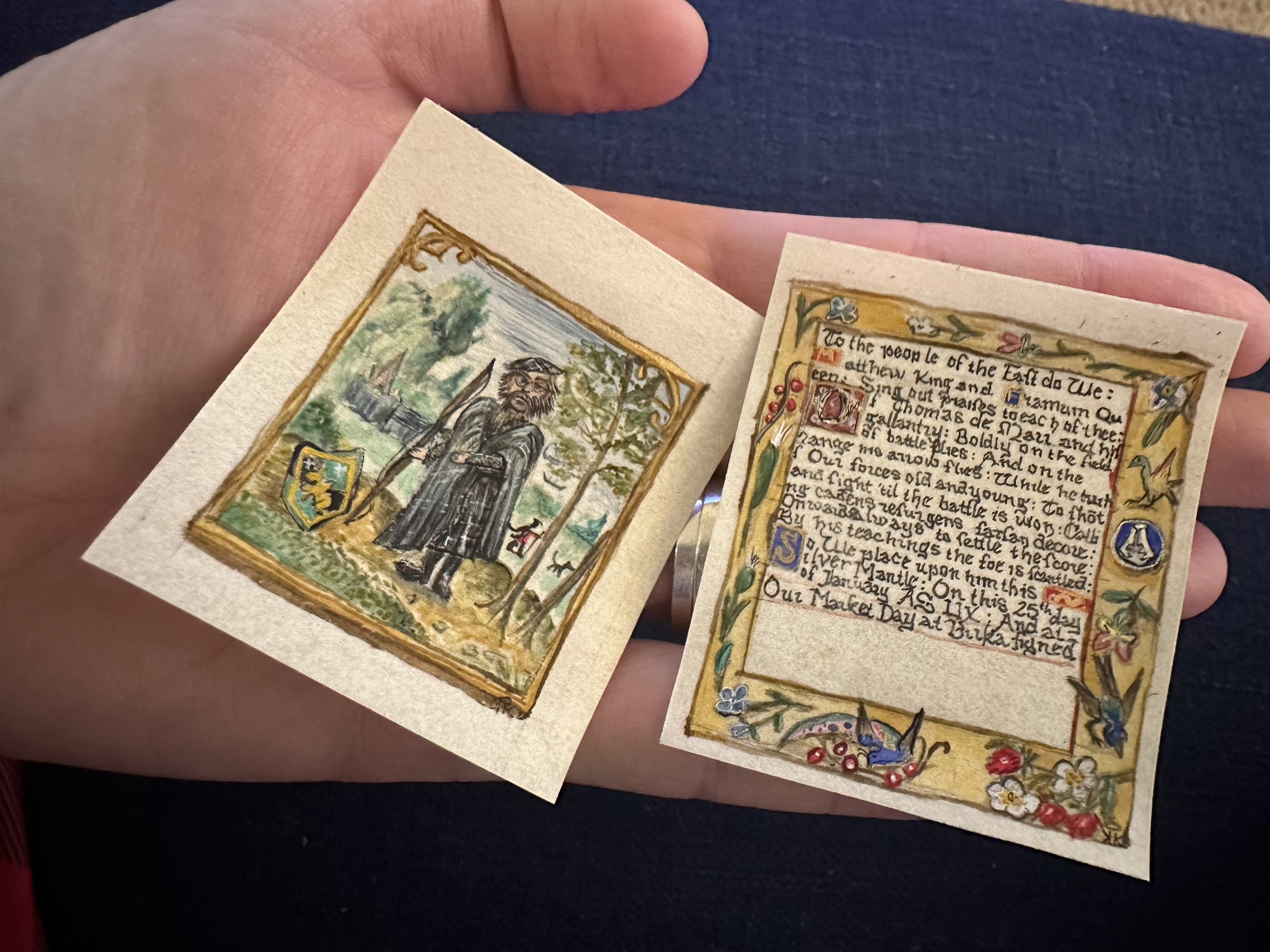
Painting always takes the least amount of time for me, and at this scale, well, let’s just say it was a good use of a snow day (timing-wise, the whole two pages took me about 4.5 hours. Yes, I know that this is not typical, and that this ability will eventually bite me in the butt). It did not take me that long to paint these up, and I love the misty qualities of the extant. But also, Simon Bening was a madman. After this point, I cut out ever-so-carefully and let Camille know that I was done (and also, I was a bit bursting with excitement because this is currently my smallest ever full scroll).
And then I got a “soooooo. . . ” DM from Camille, where I got asked if I had time to do a second scroll for Thomas, and I did, especially since the text was ready to go. The good thing was that it would not look out of place if I used the same exemplar, and that way, he’d get three pages, one with his portrait and heraldry on it, and then two separate text scrolls.
Thankfully, by using the same exemplar, I could kind of knock it out. Again, I did my calligraphy first. After that, I chose a border that I liked from the same Simon Bening extant (the pearl and jewellery border was a lot of fun, and it would provide nice contrast to the squashed bugs and birds style of the text page I had done.
Much like the the previous pages I’d done, I measured out everything as carefully as I could, did the calligraphy first, and then worked on the painting parts. Again, I made a design choice to add in the badge of the Silver Tyger instead of the daisy jewel. Unlike the other pages, the style is different, and having to use my 20/0 brushes to create the appearance of gemstones on a micro level without magnification (I am just that nearsighted, folks). This was accomplished by placing layers of base colours down first and then going in with almost watercolour-thin layers for the detail work. Places like the violet brooches especially got very light layers of ultramarine, indigo, or even my carmine/ultramarine purple. For the shadows on the red field, I used burnt umber in very light layers to keep the warmth of the red while also providing the appearance of elevation and shadow. Again, because of the size and scale, it did not take me that long to put together. I did use a little bit of the FineTec paints as accents, but on the whole, the paint was all of my handmade paint.
When I went to Birka to have it signed, I also made sure to drop off a Micron for Their Majesties East to sign, because with only a few centimeters to sign, a normal pen would not cut it.
Things I would have done differently was making sure that I had the spacing lines from the extant on the calligraphy. I also would have preferred to have a better sense of the capitals and how those translated to a better sense of use in the scroll. I also probably would have liked to better measure some of the borders, but it’s a tiny piece, the borders aren’t exactly even, and making all of the text fit in such a Lilliputian space was already difficult. The last thing I needed was to make the borders and text smaller. I also might consider making the margins a little bigger next time for ease of framing.
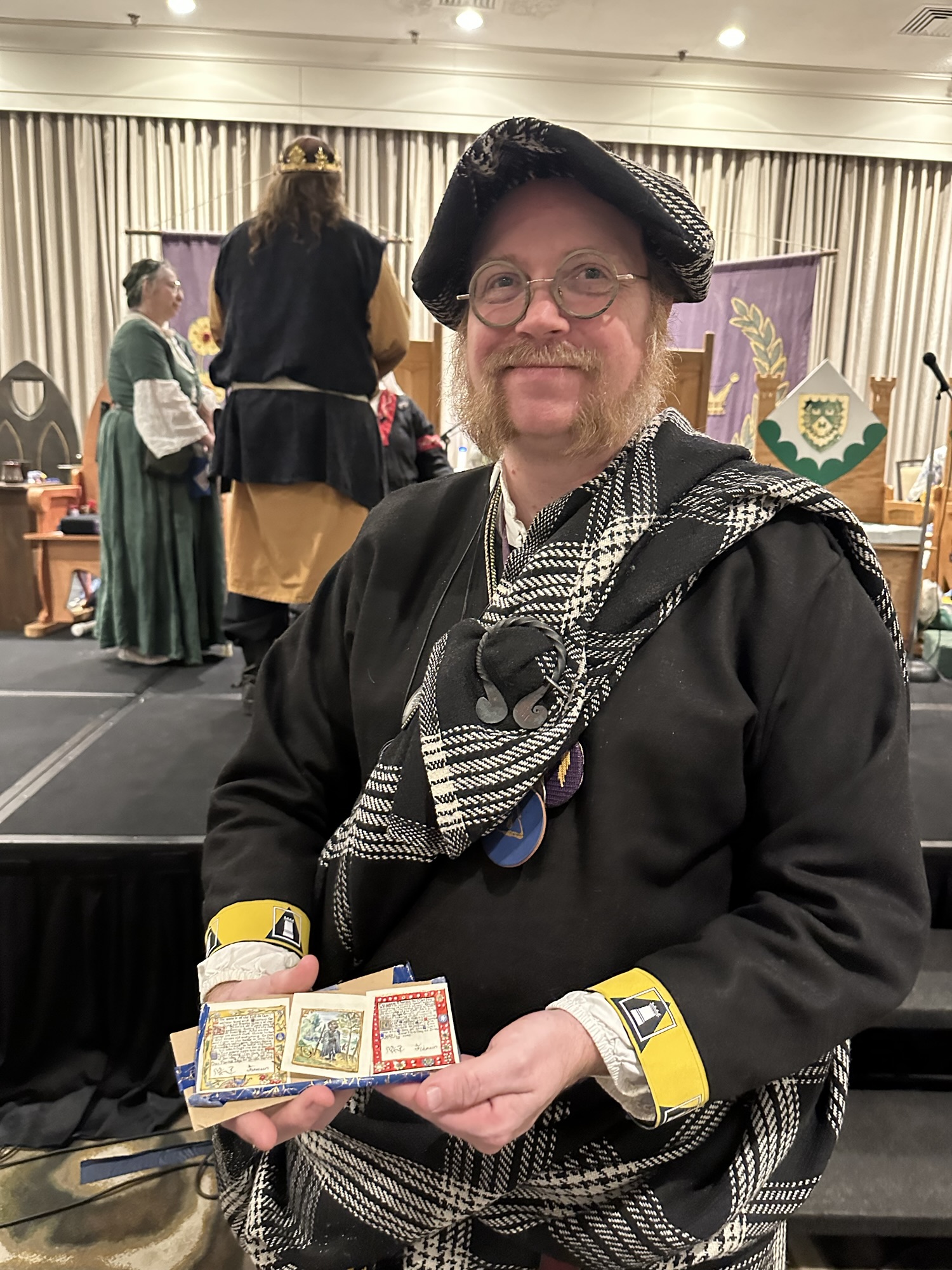
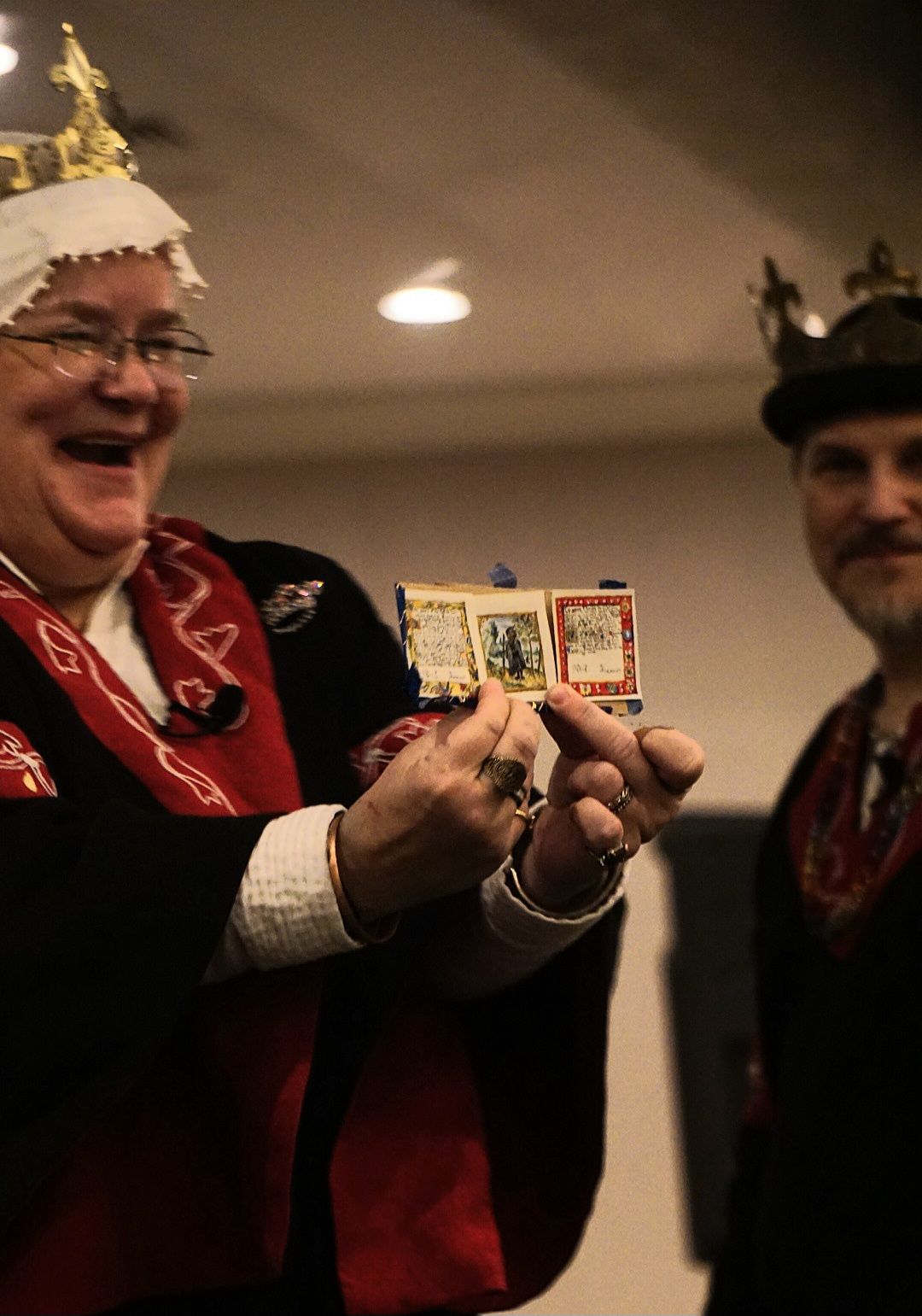
On the other hand, Thomas was very pleased with his scroll, and it’s not every day that a mere visitor to a kingdom can make them go “whoa.” I’m so pleased with how this turned out, and honestly, I’m so thrilled at the response. I really enjoyed putting this piece together and look forward to my next incredibly tiny scroll. It’s also just fun putting “DO NOT LICK” on the back of a scroll. Even though most of my paints could be considered nontoxic if ingested, I’d rather not take any chances and would rather people be safe, so I mark anything that has used my paint that was handmade in my studio as a hazard.
That said, Camille, thanks for letting me play, and Thomas, congrats on your Silver Mantle and your Silver Tyger!

- “Simon Bening,” Wikipedia, November 20, 2024, https://en.wikipedia.org/wiki/Simon_Bening. ↩︎
- Jonathan Janson, “Vermeer’s Palette: Rare or Unidentifiable Pigments (Schijtgeel and Vivianite),” Rare or Unidentifiable Pigments: Schijtgeel & Vivianite, accessed February 2, 2025, https://www.essentialvermeer.com/palette/rare.html#:~:text=Vivian%2C%20is%20a%20rare%20mineral,and%20in%20English%20medieval%20polychromy. ↩︎


Pingback: The Purple Persian at Birka (oh look! I did a sew!) | konstantia kaloethina
Pingback: Jon Chesey’s Laurel Illumination | konstantia kaloethina